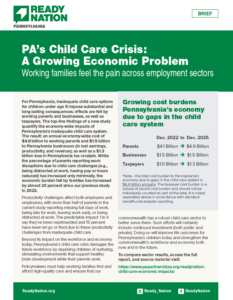
Pennsylvania’s child care crisis comes at a steep cost to working families, businesses and taxpayers. This brief examines the economic impact of inadequate child care options for children under age 5, including billions in lost earnings, productivity, revenue and tax receipts. Explore our sector-specific briefs to see how Pennsylvania’s child care crisis affects individual industries and the businesses and workers who depend on them.
This report examines how high-quality early care and education supports children’s academic, social, and behavioral development while strengthening communities. It highlights the critical role of a stable early childhood workforce and emphasizes how investments in educators help ensure children have consistent, nurturing relationships and access to quality learning opportunities.
A new report from ReadyNation shows the cost of gaps in Pennsylvania’s child care system has grown by almost $1 billion annually, costing the state’s economy well over $6 billion every year. The analysis finds that inadequate child care is driving major losses for working parents, employers, and taxpayers alike, underscoring how deeply child care challenges affect Pennsylvania’s workforce and economic strength.
At a time when employers need a reliable workforce and families need dependable care, this report makes clear that child care is not just a family issue, but an economic one. The findings highlight the urgent need for solutions to help parents find and afford child care so they can work, as well as for a stable, robust child care system that supports the economy and strengthens Pennsylvania’s long-term prosperity.
This fact sheet outlines the findings and recommendations from the OCDEL Rate Study, emphasizing the need for increased investment and systematic updates to Pennsylvania’s Infant and Toddler Early Intervention (EI) program to address underfunding, workforce shortages, and rising service costs.
Pennsylvania’s county-level Infant and Toddler Early Intervention (EI) fact sheets highlight how Part C services are reaching children from birth to age three with developmental delays or a high likelihood of delay in communities across the commonwealth. Because a child’s brain develops most rapidly in the first five years, access to timely, local EI services is critical. These fact sheets provide a closer look at county data and impact, reinforcing that investing early leads to stronger outcomes for children, families, and communities well into the future.



PAP4Children Follow 10,177 2,481
Pennsylvania Partnerships for Children is dedicated to improving the well-being of PA's 2.6 million kids. We're independent, non-partisan and non-profit.
💙 Today is National Child Health Day!
Every child deserves a healthy start and the opportunity to thrive. That means access to quality health care, perinatal health services, health coverage, immunizations, early intervention, behavioral health supports and the resources
October is National Children’s Health Month! 💙
Every child deserves a healthy start and the opportunity to thrive. That means access to perinatal health care, health coverage, vaccinations, early intervention and the resources families need from the very beginning.
💙 As Kinship Care Month comes to a close, we’re highlighting why kinship care matters.
📊 Research is clear: when children can’t stay with their parents, they do best with kin.
Kinship families can provide stability, cultural identity, resilient mental health & behavioral
🎓 Every student’s path after high school looks different. Career and technical education gives Pennsylvania students opportunities to explore their interests, build skills and prepare for the future.
We’re encouraged by continued investment in CTE and support for efforts to
The “right path” is different for every kid.
That’s why we’re investing in career and technical education — like the culinary arts and the trades here in Pennsylvania. Our latest state budget increases funding for these initiatives by another $10 million, so more kids can pursue